

Warm Spring, Shared Understanding: Clarion School Students Visit the High School Affiliated to Beijing Normal University for Cultural Exchange
Reposted from Beijing Normal University Affiliated High School
On the morning of March 9, as spring brought warmth and new beginnings, 27 students from Clarion School in the United Kingdom visited the High School Affiliated to Beijing Normal University (BNUAS) to begin a vibrant cross-cultural exchange. The delegation was led by Vice Principal Michelle Stephenson, Vice Principal Charlotte Louise Hammond, and teacher Andrew Nicholas Garlick. Wu Yinxia, Executive Chair for China of the British Educational Technology Society, accompanied the visit.
Clarion School is a highly regarded and diverse educational institution in the UK, ranked among the top 9% nationally in academic performance. Its students have previously been invited to the UK Prime Minister’s residence for educational exchange activities.
A welcoming ceremony was held in the school’s auditorium, where Wang Liping, Principal of BNUAS; Xia Xin, Senior Project Officer of the Development Planning Division at the Center for Language Education and Cooperation (CLEC) of China’s Ministry of Education; and Michelle Stephenson, Vice Principal of Clarion School, delivered remarks to greet the visiting teachers and students.
Principal Wang Liping highlighted the school’s long-standing relationship with educational institutions in the UK. Teachers from BNUAS regularly teach in Britain, while partner schools frequently visit Beijing. These exchanges have received formal appreciation from the British Embassy. Since the launch of the China–UK Youth Cultural Exchange Program by CLEC in October 2024, the school has actively participated in its initiatives. Last year, BNUAS hosted the “Oxford Students on Campus” program, and nearly 100 BNUAS students later traveled to the UK for study and cultural exchange.
She warmly welcomed the Clarion delegation and expressed hope that the students would engage openly in classroom learning and campus activities, appreciating each other’s cultures and allowing their dialogue to illuminate the richness of different traditions.
Xia Xin noted that the exchange visit represents a concrete effort to implement the cultural cooperation initiatives agreed upon by leaders of China and the UK. It also reflects a shared commitment to cultivating intercultural understanding, encouraging mutual learning between civilizations, and strengthening people-to-people connections.
Vice Principal Michelle Stephenson greeted the audience in Chinese and introduced the visiting group, noting that the delegation included students from 24 different countries, including the UK, Germany, Poland, Portugal, Spain, Brazil, India, Ukraine, Iran, Iraq, and Venezuela. She expressed confidence that the meeting of such a diverse group of students with a school boasting more than a century of educational tradition would spark meaningful cultural dialogue and mutual inspiration.
During the gift exchange ceremony, Principal Wang presented a hand-painted artwork created by BNUAS students, featuring classical Chinese poetry in both Chinese and English. The piece reflected the depth of traditional Chinese culture and showcased the creativity of the students. In return, Clarion School presented a school-uniform teddy bear, symbolizing friendship between the two schools.
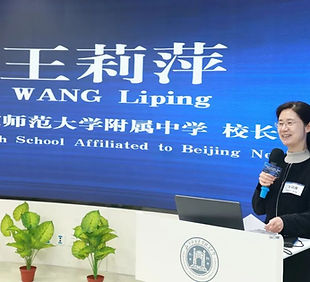
Wang Liping, principal of the High School Affiliated to Beijing Normal University, introduced the school's history and educational philosophy.

Xia Xin, senior project manager of the Development Planning Division of the Center for International People-to-People Exchanges under the Ministry of Education

Michelle Stephonson, Deputy Headmistress of Clarence School in the UK, expressed her expectations and hopes.

Cultural Exchange Through Gifts and Campus Exploration
Following the ceremony, the delegation took a group photo in front of the school’s motto stone before beginning a campus tour that combined traditional culture with modern education.
At the Xingtan cultural site, the visitors learned about the teachings of Confucius and experienced elements of traditional Chinese etiquette. At Sanwei Study Hall, they heard stories about the early education of the famous Chinese writer Lu Xun. At the Qian Xuesen Memorial Hall, they explored the life and scientific achievements of the renowned scientist and distinguished alumnus of the school.
In the school greenhouse, teacher Mr. Rui introduced the innovative shell-free chick incubation experiment, displayed student-made biological specimens, and showed the visitors young fruit and vegetable seedlings as well as a rescued injured pigeon, demonstrating students’ respect for life and nature.
At the Innovation and Technology Laboratory, teacher Mr. Dang presented student projects including a voice-controlled campus model, electronic display systems, and laser-cut creations. As a special surprise, the lab team had even 3D printed the Clarion School emblem as a gift for the visitors.


Learning Together: Classes, Sports, and Shared Experiences
The British students later visited the West Campus, where they met their Chinese student partners. The BNUAS students welcomed them with handmade greeting cards and guided them into classrooms.
The visiting students attended drama, academic English, and literature classes, actively participating in discussions and collaborative learning. In physical education classes, they joined activities such as Baduanjin, table tennis, and basketball, sharing energy, teamwork, and laughter.
At lunchtime, Chinese and British students dined together in the school cafeteria, enjoying Chinese cuisine while discussing their school lives and hobbies. Teachers from both sides also held in-depth conversations on topics such as English and physical education curricula, classroom teaching methods, student management, campus culture, and teachers’ professional responsibilities.


A Memorable Farewell and Lasting Friendship
As the day came to a close, the students and teachers gathered for a group photo in front of Jianwu Building. Together they joyfully shouted “Happy Birthday, BNUAS!”, offering early congratulations for the school’s upcoming 125th anniversary.
With warm hugs, exchanged gifts, and newly shared contact details, the students said goodbye, leaving behind unforgettable memories of friendship and cultural exchange.
The visit of Clarion School’s teachers and students not only strengthened the cultural ties between the two schools but also deepened friendships among young people from different countries. Through the dialogue and curiosity of youth, Chinese culture continues to travel beyond the campus and connect with the wider world.
